
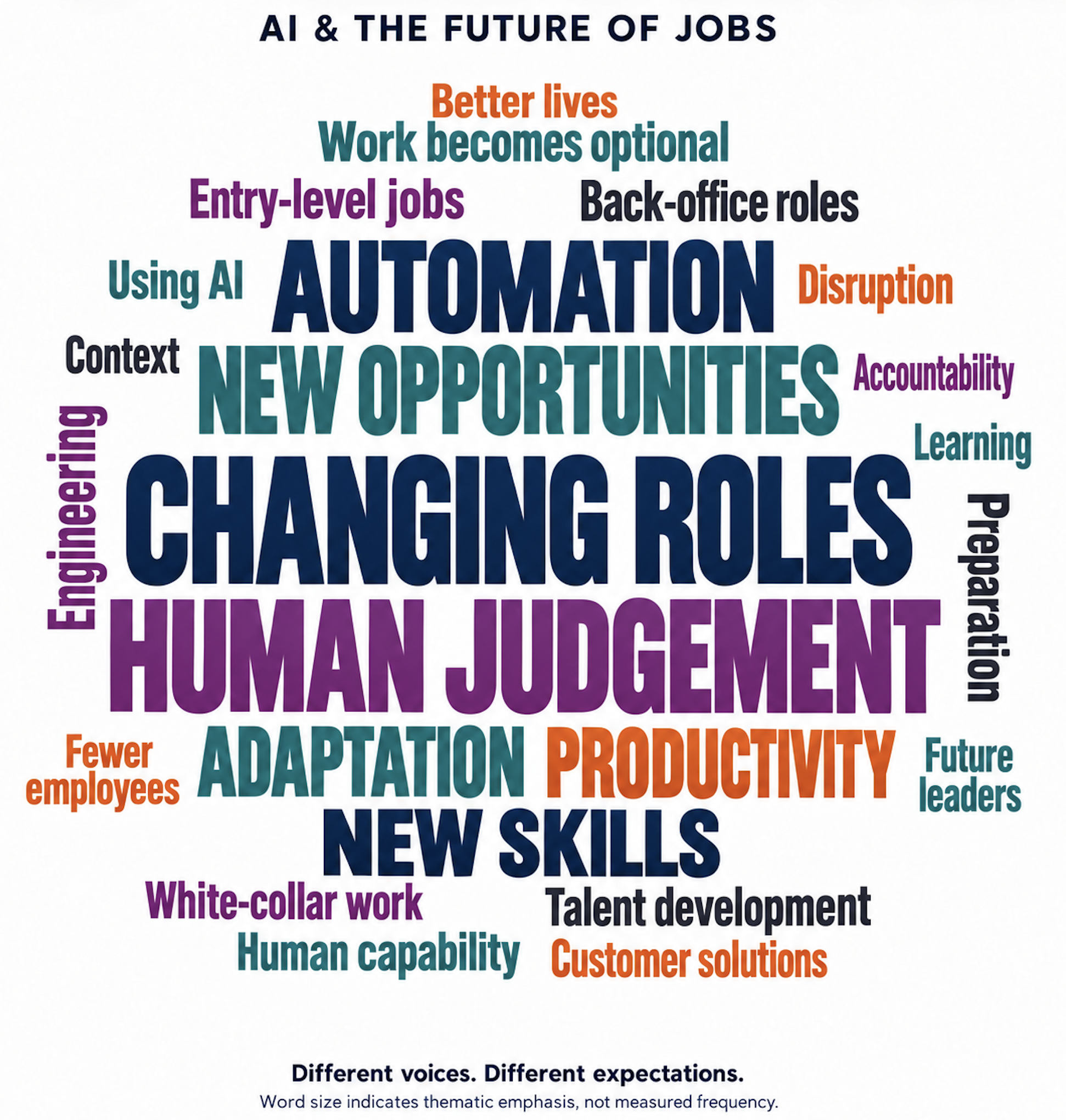
Competing visions of AI offer little guidance for the decisions teams face today. People need to understand how work will change, where human judgement belongs and what influence they have over the way forward. This Wordcloud is a map of the perspectives of 15 leaders from the top technology firms globally, and shows that opinions differ significantly.
Different predictions do not provide shared direction
Public messages about AI pull in different directions. Automation, better jobs, smaller workforces and greater human capability can all feature in the same discussion. Some statements predict technical capability. Others describe business intentions or express a preference about how AI should be used.
Andy Jassy’s June 2025 message to Amazon employees, for example, anticipated fewer people in some existing jobs, more in other types of work and a smaller corporate workforce overall. That was an expectation about Amazon’s direction, not a universal finding about every workplace. Repeating it elsewhere does not establish what another organisation should do.
For a team, the practical uncertainty runs deeper than whether a role will remain. People need to know what they are expected to contribute, how their work will be assessed and whether the standards they have learned still apply. An instruction to embrace AI leaves most of those questions unanswered.
Start with the work people actually do
Anthropic’s first Economic Index, published in February 2025, offers a useful distinction. The researchers analysed approximately one million Claude conversations, mapping use to occupational tasks. They observed both collaborative use and direct task automation, rather than evidence in that dataset of entire jobs being automated.
The study describes one product’s usage, not the whole workforce or a guarantee about future employment. Its value here is to focus attention on tasks rather than broad predictions. Different activities within the same role can change in different ways. The consequences depend partly on how the organisation responds.
Consider a customer service team using AI to draft replies. Drafting becomes quicker, but the employee still checks the customer’s circumstances, decides whether the proposed response is appropriate and accepts responsibility for sending it. A faster draft has not removed the need for judgement. It may have changed where that judgement is exercised.
If the organisation immediately increases response targets, the employee may have less time to verify each answer. If a supervisor must approve every reply, the time saved may become a queue elsewhere. If junior staff no longer learn by constructing responses themselves, the team needs another way to develop their understanding.
Human judgement needs somewhere to live
It is easy to say that people will focus on higher-value work. It is harder to specify which work that means, who is equipped to perform it and what authority they need. Judgement cannot remain a reassuring phrase in the presentation. It needs a place in the workflow.
In the service team, that means agreeing when an employee can accept a draft, when they should rewrite it and when an exception needs escalation. It also means allowing enough time for those decisions. Holding people accountable for quality while rewarding only speed sends competing signals about what the organisation actually values.
These decisions will not all be settled before a trial begins. Leaders can still distinguish what has been agreed from what is being tested. Uncertainty becomes more manageable when people know which boundaries apply and how unresolved questions will be addressed.
Readiness includes the ability to change the approach
Tool access and completed training can make an organisation look ready. The team may still lack workable answers about responsibility, workload and decision rights. That is a readiness gap between organisational confidence and the conditions people experience.
The gap will not close through communication alone. If checking takes longer than expected, someone must be able to reconsider the target. If exceptions increase, the team needs a route to change the process. Middle leaders need backing to raise these issues without being treated as obstacles to adoption.
The debate about AI will continue to produce conflicting predictions. Leaders do not need to settle it before acting. They do need to make local choices explicit and let experience influence what happens next. A team can work with uncertainty. It is much harder to work with unanswered questions that nobody has the authority to resolve.
Sources
Andy Jassy, Amazon, Update from Amazon CEO Andy Jassy on Generative AI, 17 June 2025. Read source
Anthropic, Introducing the Anthropic Economic Index, 10 February 2025. Read source


Leave a Reply