
Galbraith’s Star Model offers a useful warning for the AI era: changing the technology without realigning the organisation around it produces activity, not transformation.
Many organisations are introducing AI as though they were installing a faster tool into an otherwise stable workplace. Employees receive access, training and encouragement to experiment. Leaders then wait for productivity to appear.
But the workplace around the technology often remains unchanged. Decision rights still reflect the old flow of information. Roles still contain the same accountabilities. Performance measures reward the same outputs. Career paths assume junior employees will learn through work that AI may now perform. Managers are expected to reconcile the difference.
This is why AI adoption can be widespread without becoming organisational change. The technology has moved; the organisation has not.
An old model explains a new problem
Jay Galbraith’s Star Model describes organisations through five connected design choices: strategy, structure, processes, rewards and people. Strategy establishes direction. Structure locates power. Processes move information and decisions. Rewards influence behaviour. People practices build the necessary skills and mindsets.
Its power lies less in the five categories than in their alignment. Galbraith argued that design choices send employees a clear and consistent message only when they reinforce one another. Alter one point substantially and the others may no longer fit.
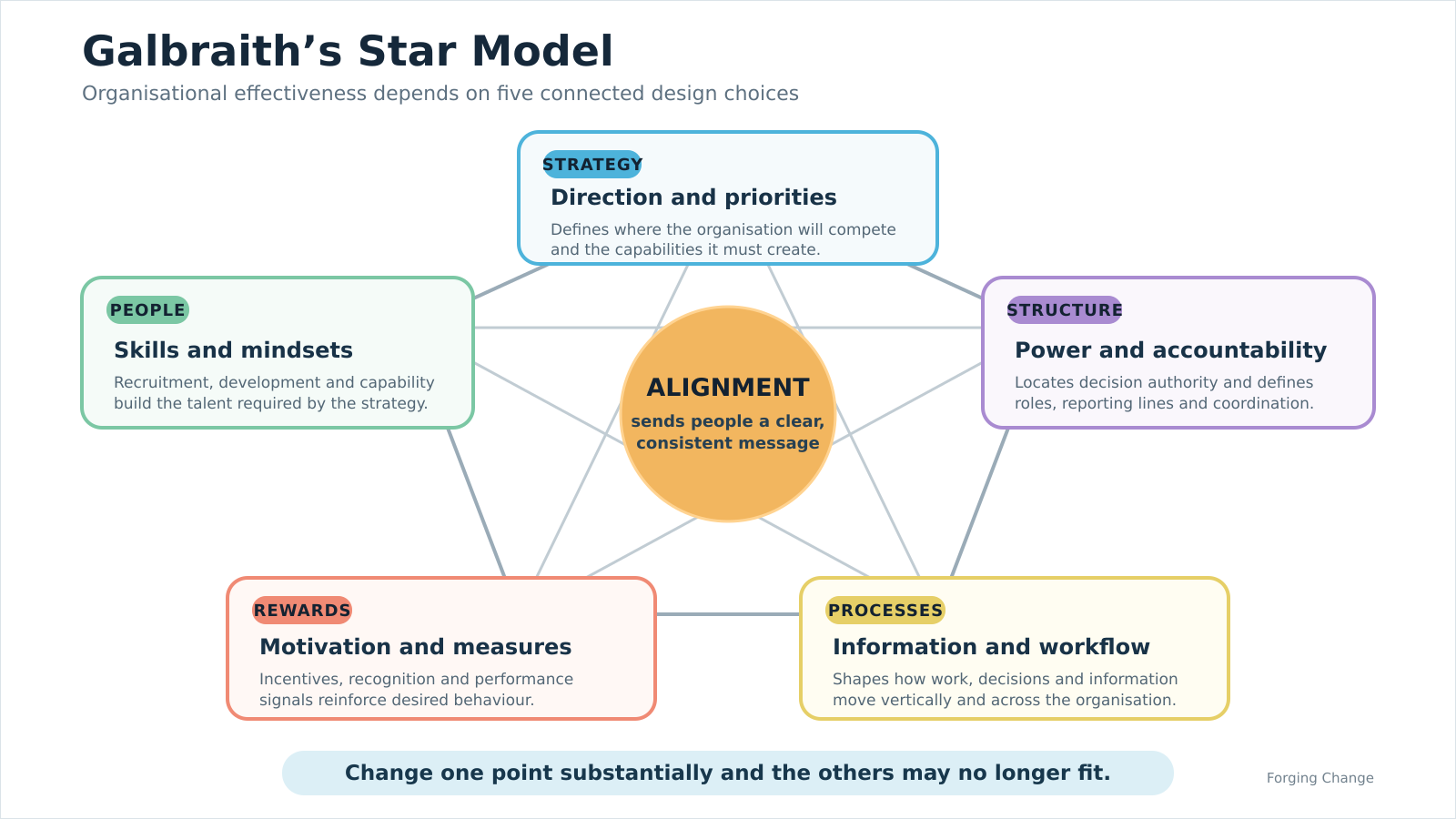
AI is doing exactly that. It changes who can produce knowledge, how quickly work moves, where judgement is required and what expertise looks like. Yet many implementation programs concentrate on the people point—licences, training and adoption—while treating the rest of the star as fixed.
AI is not another point on the star
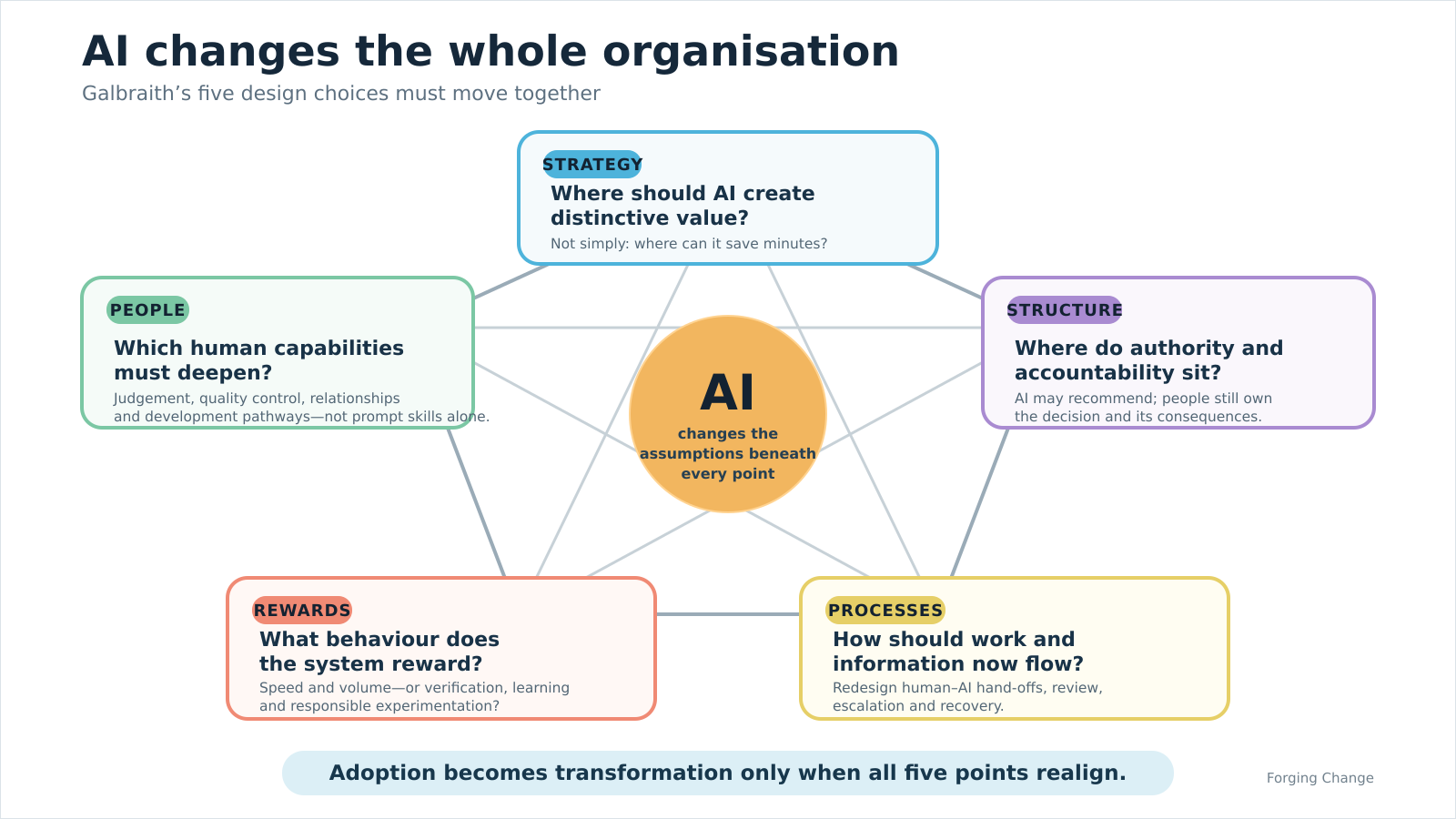
AI should not be added to the model as a sixth component. It is better understood as a force that changes the assumptions beneath every component.
At the strategy point, leaders must decide where AI is meant to create distinctive value, not simply where it can save minutes. At the structure point, they must reconsider who has authority when recommendations are generated by machines but consequences remain human. Processes must be redesigned around new hand-offs between people and AI, including review, escalation and recovery when outputs are wrong.
Rewards may be the most neglected point. If people are assessed on volume and speed, they have little reason to pause, verify or share what they learn. Microsoft’s 2026 Work Trend Index found that only 13 per cent of surveyed AI users said they were rewarded for reinventing work with AI when immediate results were not achieved. The organisation may publicly encourage experimentation while its performance system quietly punishes it.
The people point also extends far beyond prompt training. AI changes the mix of judgement, relationship-building, quality control and domain expertise required in a role. It may remove some of the routine work through which employees once developed those capabilities. That makes job design, learning and career progression part of AI adoption—not downstream HR issues.
Misalignment appears first in the team
The consequences are usually experienced at team level. A tool accelerates document production, but approvals remain slow. Employees generate more analysis, but no one knows which conclusions can be acted upon. Junior work disappears, while managers acquire more checking, coaching and exception-handling. Saved time is absorbed by additional demand rather than becoming genuine capacity.
Current research supports this systems view. Deloitte’s 2026 human-capital research found that organisations intentionally redesigning roles, workflows and decision-making around human–AI collaboration were more likely to exceed return expectations and provide meaningful work. Microsoft’s study of 20,000 AI users similarly concluded that culture, manager support and talent practices accounted for twice the reported AI impact of individual effort alone.
These findings do not prove that one universal design will succeed. Galbraith’s model argues the opposite: organisational design must follow strategy, and every design involves trade-offs. Centralising AI capability may improve control and reduce duplication, but move decisions away from the work. Decentralising it may encourage useful experimentation, but fragment standards and accountability.
The real work begins after adoption
The important leadership question is therefore not, “Are our people using AI?” It is, “What has AI changed about how this organisation should work?”
That question exposes the design choices hidden beneath adoption: where judgement belongs, how work should flow, what behaviour is rewarded, which capabilities must deepen and what managers now need the authority to change.
AI will not transform an organisation merely because employees use it. Transformation begins when the organisation is redesigned to make their new capabilities coherent—and when all five points of the star start pointing in the same direction.
Sources
- Jay R. Galbraith, The Star Model™, organisational design paper.
- Deloitte, 2026 Global Human Capital Trends, 4 March 2026.
- Microsoft, 2026 Work Trend Index Annual Report: Agents, Human Agency, and the Opportunity for Every Organization, 5 May 2026.

